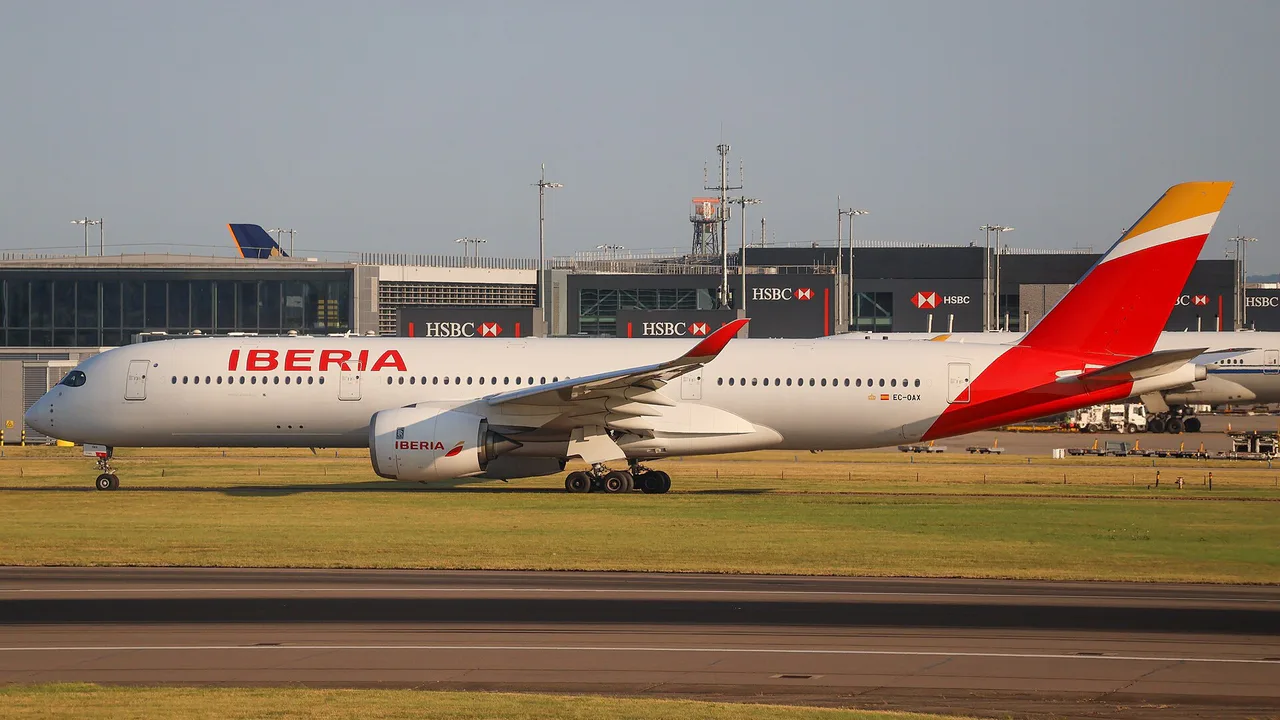
To show what changes when an aircraft gains high-speed connectivity, Iberia chose something that could not be repeated the following day: transmitting a solar eclipse from the air. The action made Starlink a visible tool inside a story with a time, a route and scientific participants. Its commercial proposition was more precise than associating the airline with a spectacle. It made a product improvement intelligible before installation across the entire fleet. The distance between demonstrating a capability and making it universally available is also the case’s main tension.
The August 3, 2026 announcement prepared a special August 12 flight using an Airbus A321XLR, with observation over Palencia. Iberia’s event page specified 7:35 p.m. Madrid time as the broadcast start; departure was scheduled for 6:45 p.m. Confusing those times would erase part of the editorial work: the transmission had its own entrance, separate from the beginning of the aircraft operation. That distinction matters when explaining how a short phenomenon becomes a longer piece of useful content. Iberia announcement Event page
Subsequent documentation takes the story beyond the announcement. Sobrevuelo, the scientific expedition’s project, publishes post-flight images from IB 1473 and states that sky-live.tv transmitted totality live from the aircraft. Its photographic record places totality between 18:28:23 and 18:30:30 UT: two minutes and seven seconds, or 127 seconds. This is evidence supplied by expedition participants, not an audience audit or an Iberia commercial result. It establishes what those participants document without substituting for a performance test of onboard connectivity. Sobrevuelo record
A short window requiring extensive preparation
The eclipse imposes a physical limit on the demonstration. The recorded 127 seconds could not be extended if a video input failed or a platform started late. That changes content production: the transmission needs to be ready before the decisive moment and explain why viewers should remain. Here attention depended on more than persuasive messaging. It required coordination between crew, scientific equipment, video transmission and distribution channels around an opportunity that could not simply be rescheduled. The technical service became part of the event’s ability to reach people outside the aircraft.
Totality duration is also different from livestream duration. The announced start left room to contextualise the observation and show preparation. That difference allows an extremely short scene to have an intelligible narrative. A fragment of darkness seen on a phone without context might resemble any other eclipse. Explaining the flight and the transmission of pictures from the aircraft establishes the connection with the connectivity service. Without that link, the astronomical phenomenon could capture the entire memory of the action while leaving Iberia’s contribution unrecognised by the audience.
Sobrevuelo describes four onboard experiments, including transmission and work concerning the solar corona and human response. This scientific context helps give the flight a verifiable purpose beyond advertising scenery. We do not report experimental findings: conducting a mission does not establish its results. For brand communication, the value lies in an improved service supporting a real activity. Science supplies content for the story, but should not become an implicit guarantee of every commercial claim made about the wifi. The source documents participation and purpose rather than independently validating the product.
Post-event photographs also change the available evidence. Iberia’s invitation page retains future-tense descriptions, while the project displays preparation, equipment and observation already completed. Reporting needs to recognise that temporal difference. The announcement explains what was intended; the subsequent archive supports the expedition and broadcast having taken place, according to participants. Neither surface by itself establishes how many people followed the content or what they understood about connectivity afterward. The update adds evidence of execution without manufacturing an audience outcome from the existence of photographs.
What a broadcast demonstrates and does not measure
Sending images from the aircraft illustrates a particular use of the link: transmitting content outward during flight. It is especially appropriate for a connectivity promise that can remain abstract when presented solely as a speed. The viewer sees an activity dependent on moving information. Compared with a picture of a passenger using a screen, the commercial difference is the external event requiring simultaneous operation. That makes the service’s usefulness intelligible, because the footage has to leave the aircraft while the phenomenon occurs rather than being uploaded at leisure afterward.
The case does not contain a performance test covering every passenger. Concurrent load, production-equipment access conditions and measured speed during the stream are unknown. We therefore do not turn the broadcast into a guarantee that every traveller will receive the same experience on every seat or route. The demonstration’s value is functional: a task is presented as possible and documented as completed by participants. A personal performance promise would require different observation and stated conditions. This distinction preserves the concrete proof without allowing it to expand beyond what the material establishes.
There is also a discrepancy that must remain unresolved. Sobrevuelo uses 11,000 metres in presentation blocks, but the measured-photograph section identifies 9,400 metres during totality. Iberia’s invitation announced observation above 10,000 metres. Without clarification from organisers, we do not select a definitive event altitude. The discrepancy does not invalidate the flight or the images, but prevents a promotional altitude becoming a confirmed technical measurement. The commercial analysis does not need to resolve it artificially, and omitting the problem would weaken the accuracy of an otherwise concrete account of the expedition.
We also avoid transferring audiences from other expeditions into this one. A historical audience figure for a previous stream, even if displayed close to the 2026 archive, is not IB 1473’s audience. The consulted material provides no verifiable unique-viewer count for this action. Defining that boundary prevents an attractive but unsupported conclusion: moving from a visually memorable event to a claim that millions understood Starlink or that Iberia obtained additional reservations from showing it. Event execution, attention and commercial contribution require different evidence and should not be joined by assumption.
The service began before the eclipse
This demonstration did not mark the rollout’s beginning. Iberia announced on June 24, 2026 that its first Starlink-equipped aircraft had flown the previous night to São Paulo, registered EC-MAA. That release described progressive introduction over the following two years. It also presented speeds up to 500 Mbps and free access in every cabin as service features. The advertised maximum is a corporate specification, not a measured eclipse-broadcast speed or a per-passenger result. First equipped aircraft announcement
Speed and free access address two obstacles reported by travellers. In Inmarsat’s July 2023 survey reported by Statista, 51% identified a slow connection as a factor that would discourage onboard-wifi use, and 47% identified having to pay. This is historical international survey context, not an Iberia or Starlink measurement. The announced eclipse broadcast makes a task requiring connectivity visible; service information then needs to explain the conditions under which a passenger can use it. The stream does not establish that these obstacles have been resolved throughout the fleet.
Speed and cost were the leading stated barriers
Factors that would discourage connecting to aircraft wifi, international survey, July 2023.
Tap or hover for details. All values are also available in the data table.
Collapse notes
Inmarsat online survey of 11,053 people who had flown in the preceding twelve months. Country breakdown and selection are not detailed in the accessible entry. Stated 2023 factors, not observed abandonment, measured speed, Iberia experience or 2026 Starlink availability.
Explore the data table
| Category | Respondents |
|---|---|
| Slow connection | 51% |
| Paid access | 47% |
| Too much advertising | 25% |
| Complete a form | 24% |
The sequence changes how August’s action should be read. An implementation was communicated first; an event was then selected to show one application of the service. The eclipse translated the product into an experience comprehensible from the ground. Simply stating that the technology was available would not accomplish the same task. The story needed to explain why connectivity was useful, and sending images of a time-limited phenomenon supplied a concrete answer. The flight served a product explanation rather than proving that deployment had already reached every traveller.
The two-year horizon introduces a problem specific to fleet renewal. Advertising an improvement can reach the entire audience long before every customer can experience it. Somebody remembering the stream and subsequently booking may not know whether their aircraft offers the service. Demonstration therefore needs to coexist with operational availability information. A broad promise without that precision could turn a real improvement into a frustrated expectation for a traveller whose flight is not yet equipped. The effectiveness of the story increases the importance of maintaining that distinction on booking and service-information surfaces.
The first aircraft’s registration and IB 1473 refer to different facts. The São Paulo flight establishes the announced beginning of commercial introduction; the special flight supplies a subsequent editorial application. We do not treat them as the same aircraft or as evidence of complete coverage. For a content strategy, this distinction is useful: each milestone explains a phase in the product’s story. Accumulating milestones can sustain communication during installation, provided it does not obscure which part of the fleet already supports the experience. Progress and completion should remain separately identifiable.
Six channels do not produce six additive audiences
The eclipse page linked Instagram, TikTok, X, Facebook, YouTube and LinkedIn. Six distribution surfaces offer different entrances, but one person may move through several. Adding reproductions across them would not automatically produce unique viewers. Nor does a brief playback have the same meaning as following preparation and totality. The action’s architecture can broaden access; measuring attention requires defining what viewers did on each surface and recognising possible repetition. The channel count is an observable design fact, not a measure of reach or an achievement to compare with reservation volume.
Usage context also prevents these entrances from being treated as equivalent. The GWI series reported by Statista records monthly Instagram use by 73.5% and LinkedIn use by 28.1% of internet users aged 16–64 in Spain in Q3 2025. One person can appear across several platforms. This comparison does not establish where the eclipse was viewed: it shows that distributing one story across six surfaces does not create six independent audience blocks. A link to the owned page needs to retain the context each fragment leaves out.
The six social entrances have different usage reaches
Monthly use of platforms linked from the eclipse page; Spain, third quarter of 2025.
Tap or hover for details. All values are also available in the data table.
Collapse notes
GWI / DataReportal online panel of internet users aged 16–64. Spanish N not disclosed in the entry. Overlapping monthly use, not ad reach, unique viewers or Iberia livestream audience; percentages must not be added together.
Explore the data table
| Category | Respondents |
|---|---|
| 73.5% | |
| TikTok | 50.5% |
| X | 36.4% |
| 68.5% | |
| YouTube | 49.3% |
| 28.1% |
The owned page serves a different role from a social publication. It gathers the schedule, aircraft, scientific context and a link to Starlink information. That combination helps someone arriving from a fragment reconstruct the story. For Iberia, it also provides a transition from cultural curiosity to understanding the service. We do not know how many visitors made that transition. What can be observed is that the documentary route exists and product information has a place within it. The page connects the broadcast to a feature of travel rather than leaving the two unrelated.
An editorial adaptation of the scene could emphasise different tasks for different entrances. A short video needs to identify that the signal comes from the aircraft; a longer piece can explain preparation; a product query needs availability and conditions. These are analytical proposals, not outcomes attributed to particular Iberia posts. Useful coordination maintains the connection between the scene and connectivity without requiring every audience to consume an identical duration or know the earlier announcement. The adaptation’s purpose is comprehension of the same underlying fact, rather than multiplying vaguely branded versions of the spectacle.
The aftermath matters especially because totality lasts briefly while product communication continues. Expedition images and the archive film can preserve the demonstration for people absent at the announced time. Without context, repetition may remain spectacle. With a date, flight identification and an explanation of the signal, it becomes a consultable account of one wifi use. The content’s useful life depends on that information, not on pretending the event is still happening live. An archive can carry the explanation forward while clearly separating a completed occurrence from current service availability.
Moving from curiosity to product without forcing a sale
People watching an eclipse are not necessarily choosing airline tickets. An immediate booking prompt could disregard the actual purpose of their visit. A more coherent commercial transition would explain which service enabled transmission and what travellers can expect from its installation. Iberia’s Starlink link serves a documentary function within that journey. It does not establish conversion, but allows curiosity to move beyond an isolated image unrelated to the product. The next useful action may be understanding the feature, rather than purchasing a journey whose date or destination has not yet been considered.
Evaluating that transition would involve observing connectivity-information queries originating from eclipse content. A next step might be checking availability for a journey, without requiring every query to end immediately in a sale. Flying decisions depend on destination, dates and price as well as onboard service. Content has a reasonable function if it improves understanding of a relevant difference when comparing options. Attributing every subsequent booking by a visitor to the broadcast would overstate that function. The useful connection is a defined change in understanding or consideration, not a blanket attribution rule.
Free connectivity also changes what is being sold. The release does not direct viewers toward a separate wifi purchase; it highlights a feature included in the announced travel experience. Its commercial return might appear as airline preference or valuation of a journey rather than direct revenue from the connection. Those outcomes would need specific evidence. The distinction prevents assessing the demonstration as if it were a campaign selling an add-on with a price and transaction separate from the ticket. The financial mechanism is tied to the wider product rather than a documented standalone upsell.
A before-and-after perception comparison could ask what audiences understand about service availability and which tasks they consider it useful for. That proposal would be more informative than asking only whether they remember the eclipse. The specific risk is incomplete association: remembering Iberia transmitting images from an aircraft while assuming all its flights already offer the same connection. Better recall accompanied by that expectation error would not be an unqualified commercial success, however numerous the reproductions. Comprehension needs to include the rollout conditions that constrain delivery of the advertised experience.
Documentation preserves the connection with the brand
The scientific record expresses its times in UT, while the invitation uses Madrid local time. That difference matters when footage travels beyond Spain or is consulted later. Preserving the date and explaining the time zone prevents totality being presented as occurring before the announced broadcast began. Accurate timing links a scene to the same event across distribution surfaces and separates the original transmission from later playback. The archive remains intelligible without relying on whatever local clock a platform displays.
The archive also needs to preserve who did what: Iberia supplied the flight and announced connectivity, while the expedition documents observation and the scientific signal. Commercial credit does not require erasing those participants. Identifying them explains why the content deserves attention and which task the service supported. An edit showing only a logo and the Sun could simplify the scene until its mechanism disappears. The case’s authority comes from a recognisable task, particular equipment and an attributed transmission rather than a speed promise repeated over spectacular imagery.
A memorable demonstration creates a later obligation
The Sobrevuelo archive adds something conventional advertising imagery rarely reproduces: equipment installed, people working and recorded totality with particular times. That material supports a story about real activity without needing a synthetic scene of connected passengers. Its strength depends on preserving attribution and date. Audiences can recognise evidence of one service use while reporting distinguishes participants’ documentation from independent performance or market assessment. This approach gives the scene more substance than a generic connectivity illustration while keeping its claims proportionate to the available record.
Iberia’s demanding commercial consequence begins after that scene. The more memorable the broadcast becomes, the more important it is for travellers to find clear information about their own flights. The airline demonstrated an improvement within a 127-second window, but the relationship extends through a two-year installation and particular journeys. Content can win attention quickly; sustaining the promise requires availability and subsequent experience to reach the precision of the eclipse appointment. The event earns a product story, while fleet operations determine which customers can actually live that story afterward.
In this article

Marian Vasile
Marian Vasile is a MarTech and growth professional. His work spans product marketing, SEO, paid advertising and deep online tracking, including behavioral analytics and attribution.